

Category: Treatment FAQs
Frequently asked questions about our dental treatments
Why do I have tooth sensitivity?
Many people suffer from sensitive teeth for a variety of reasons, this article highlights why you may suddenly develop sensitive teeth, what you can do about it at home, what treatments the dentist may be able to offer you and how to reduce the pain from tooth sensitivity.
What causes tooth sensitivity?
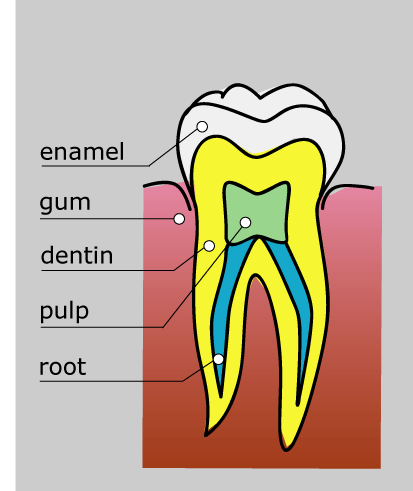 Your teeth are made up of three primary layers:
- The nerve and pulp. This is the deepest living part of your tooth, it contains the nerve and has blood flowing through it to keep your tooth alive, it is protected by two out of protection layers.
- The dentine. This is the softer portion of your tooth, it gives the tooth it’s primary colour and its role is to support the hard yet brittle outer enamel.
- The enamel. This is the hardest substance in the human body and protects the outer portion of your tooth.
Sensitivity occurs when hot or cold substances, such as eating ice cream, get too close to the nerve, there are many reasons this could happen, including:
- Tooth wear caused by over brushing.
- Gum recession caused by over by over brushing or general ageing.
- Cracked teeth caused by trauma.
- Decay in teeth caused by poor oral hygiene.
- Tooth grinding or clenching.
Why are my teeth suddenly sensitive?
The key to understanding this is to think about how the hot or cold feeling may be getting through to the nerve. If you have had a recent trauma then perhaps the tooth is correct. If you haven’t been to the dentist for a while perhaps there is an area of tooth which is decayed.
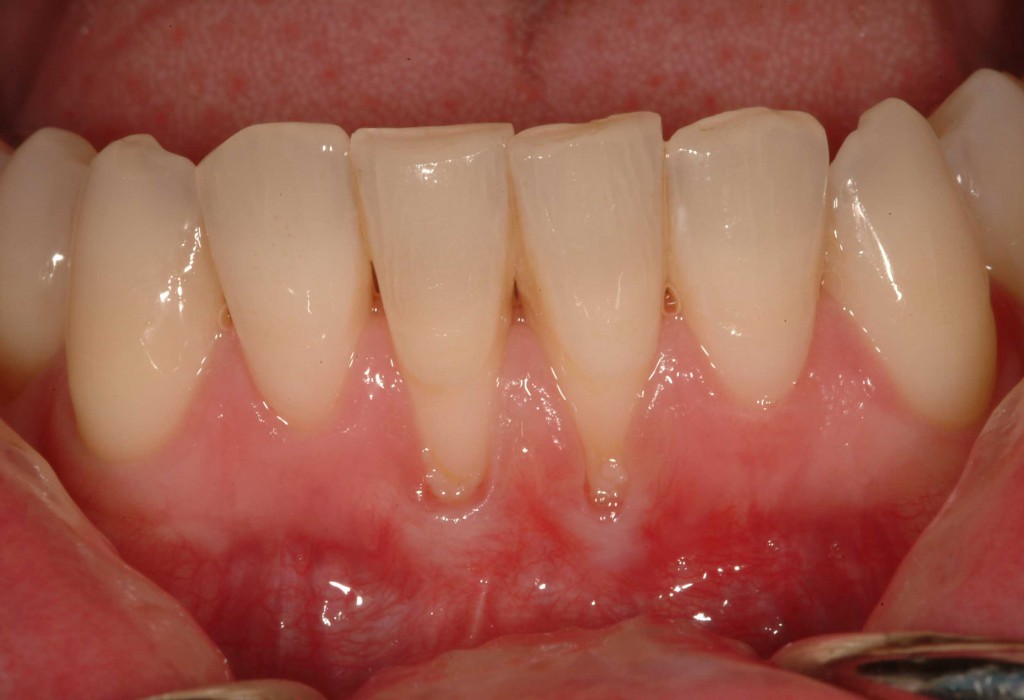
The image below shows gum tissue recession around the gum line, possibly caused by over brushing. The enamel is thin in this area which can easily lead to teeth sensitivity.
If you can’t immediately identify what the problem is then visiting a dentist or dental hygienist may be best option.
How do you stop sensitive teeth pain
If you have sensitive teeth with no obvious cause then you may find that using a protection and relief toothpaste such as Sensodyne may help.
How does Sensodyne work?
These toothpastes work because there are tiny holes, called tubules, in the dentine of your tooth. If the enamel becomes eroded away then these tubules can transmit the hot and cold through your tooth. These toothpastes work by quickly creating a barrier so that the hot and cold feeling can’t be transmitted to the nerve.
However, it’s worth noting that these types of toothpastes WILL NOT work if the sensitivity is caused by excessive enamel or dentine loss such as cavities, excessive wear or cracks caused by trauma.
How long does tooth sensitivity last?
Tooth sensitivity is usually only instantaneous when the nerve becomes exposed to hot or cold. Remove the hot or cold and the sensitivity goes away. However, the reality is that this is not practical to do on a day by day basis, we have to eat and drink after all! Unfortunately, if your teeth are sensitive they won’t get better on their own, you will either need to use a relief and protection toothpaste or visit a dentist to ascertain why your teeth are sensitive.
What does the dentist do for sensitive teeth?
The basic premise for reducing tooth sensitivity is to protect the outer surface of the tooth to prevent the hot and cold sensations been transmitted through to the nerve, or in extreme circumstances to remove the nerve itself. There are a variety of ways of treating sensitivity at the dentist, including but not limited to:
- Fluoride treatments to strengthen tooth enamel. These fluoride gels can be applied topically at the dentist or trays can be provided for use at home.
- Bonding. Composite bonding materials can be used to bonded to the outer surface of the tooth to rebuild the enamel where it has been lost. This can cover up the dentin hypersensitivity.
- Surgical gum graft (Please see the explanation video below). If the sensitivity is caused by excessive gum resorption which exposes the more sensitive root of the tooth then a gum graft to replacing some of the gum tissue may be undertaken to cover up some of this exposed area around the gum line.
- Root canal. In extreme circumstances a root canal can be used to remove the nerve of the tooth. This is not normally a preferred option and will only be undertaken in extreme circumstances.
Summary
One of the key things to focus on is brushing your teeth and maintaining good dental care throughout your life, ensuring you brush and floss regularly. Tooth sensitivity is a common problem, particularly in later life as the gum becomes more exposed and the teeth wear. Certainly, this is one of the best ways to prevent tooth sensitivity. If you are older then be aware about using a soft bristled toothbrush, watching to ensure you don’t consume too many acidic foods and drinks and be aware if you grind your teeth. Cold air can also affect sensitivity, so you may find you need to wear a scarf in cold weather.
 Dr Nishan Dixit is the founder and principal dentist of Blue Court Dental. Patients enjoy his relaxed, friendly and gentle approach while experiencing his meticulous attention to detail. He has a special interest in providing smile makeovers, natural-looking white fillings and cosmetic braces, but also provides a range of treatments from preventative and general dental care to complex dental rehabilitation.Latest posts by Dr Nishan Dixit (see all)
How to Look After Children’s Teeth Properly
Most parents want to look after their children’s teeth in the best way possible but often find the advice given confusing or difficult to follow. In this blog post we set out to explain in simple terms the easiest way to look after children’s teeth, prevent future problems and keep visits to the dentist to the absolute minimum.
1. Brush using the right kit, in the right way at the right time
Using the right kit
Children have smaller mouths than adults, clearly and so need to have a smaller toothbrush. If you try to clean a child’s mouth with an adult’s brush you will find that you will be missing parts of their teeth, particularly right around the back teeth. Use a child’s toothbrush with a pea sized amount of Children’s toothpaste. Children’s toothpaste has a reduced amount of fluoride compared to adults toothpaste, this ensures that your child does not receive too much fluoride.
Brushing in the right way
Brush your children’s teeth twice per day. Up until the age of 7 we recommend brushing your children’s teeth for them and then supervising after this age. When you brush clean for 30 seconds in each quadrant, top left, top right, bottom left and bottom right ensuring that you clean the biting surface, tongue side and cheek side of your Children’s teeth.
Brushing for the right amount of time
The whole process should take 2 min and this should be done twice per day.
2. Maintain a healthy diet
 Maintaining a healthy diet is important for overall body health as well as dental health, but the two are linked. The simplest piece of advice, and probably the most important, is to watch the amount of sugar that your child has in their diet. It’s not just the added sugar (such as on cereal in the morning) it’s the hidden sugar in so many food items particularly fizzy drinks and processed food. A good way to monitor this is to use the governments sugar smart app which we have blogged about in the past.
Sugar is so damaging because it feeds the acid excreting bacteria which cause dental decay. Limiting the amount of sugar your child eats will have a dramatic effect on tooth decay.
3. Visit your dentist

We would say that, wouldn’t we! But it’s true, your dentist is able to detect the early warning signs of gum disease and dental decay before you will notice it at home. They can advise on your child’s oral health care routine and let you know if there are areas that you are missing whilst you are cleaning. It’s extremely important to ensure that your child’s over all dental health remains in good condition throughout their lives, and this starts from an early age.
Many people mistakenly believe that because children lose their teeth that they don’t need to worry about looking after them…… they will get a new set after all. This is a misconception, the habits that we form at an early age will continue into later life. If your children don’t have a good oral health care routine with their baby teeth, why would they change that routine and habit when they lose their baby teeth? The reality is that they won’t and those same bad habits will continue through to the adult teeth… Which don’t get naturally replaced.
For further advice and information please request an appointment with our dental hygienist at our practice in Harrow, we’ll be happy to answer any questions and give you advice on your own dental health care routine.
Images courtesy of freedigitalphotos.net
How do you know which dental specialist to see?
In life we know that if things are particularly complicated then a specialist in that area is the best person to sort it out. Dentistry is no different. Understanding which specialist to see can often be rather confusing so in this blog post, our Harrow dentists takes some time to go through each of the specialist areas to help you understand which person can best solve your dental problems. The following definitions are taken from the General Dental Council specialist register.
Orthodontist
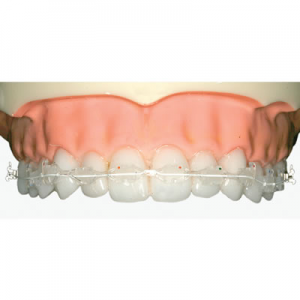
The development, prevention, and correction of irregularities of the teeth, bite and jaw.
Many general dentists are now offering what are known as either short term orthodontics (STO) all limited outcome orthodontics, these treatments move teeth to a more cosmetic situation and include treatments such as Invisalign (clear braces), Six Month Smiles (tooth coloured brackets) and the Inman aligner (rapid orthodontics). These systems typically only move front teeth and don’t address more complicated biting problems.
A specialist orthodontist will typically use more complex techniques to move teeth greater distances. A specialist orthodontist can correct biting problems and even work with a growing jaw during the early teenage years to help move the jaw and bone into a better position.
If you have a child whose teeth don’t seem to be biting correctly then a specialist orthodontist may be the person to see, many children begin their orthodontic treatment at the age of 12, but it’s worth seeing an orthodontist sooner if you suspect they could be a problem.
Adults with crooked teeth could start with a general dentist, see if one of the short-term orthodontic techniques could work and have a discussion about whether a specialist orthodontist would be better suited due to biting problems.
Periodontist
The diagnosis, treatment and prevention of diseases and disorders (infections and inflammatory) of the gums and other structures around the teeth.
Gum disease can often progress painlessly, it can start as red inflammation with bleeding on brushing, this may be a sign of gingivitis. As this gingivitis and inflammation spreads it can move down the tooth towards the root at this point it becomes the more serious periodontitis which can lead to tooth loss.
At this point your dentist will probably refer you to a periodontist. The periodontist will then look at the extent of any disease and work with the treatment and help you prevent it happening again.
Prosthodontists are also the specialist which place dental implants. Their detailed knowledge of the gums and other structures surrounding the teeth makes them the perfect person to restore your missing teeth with implants.
Prosthodontist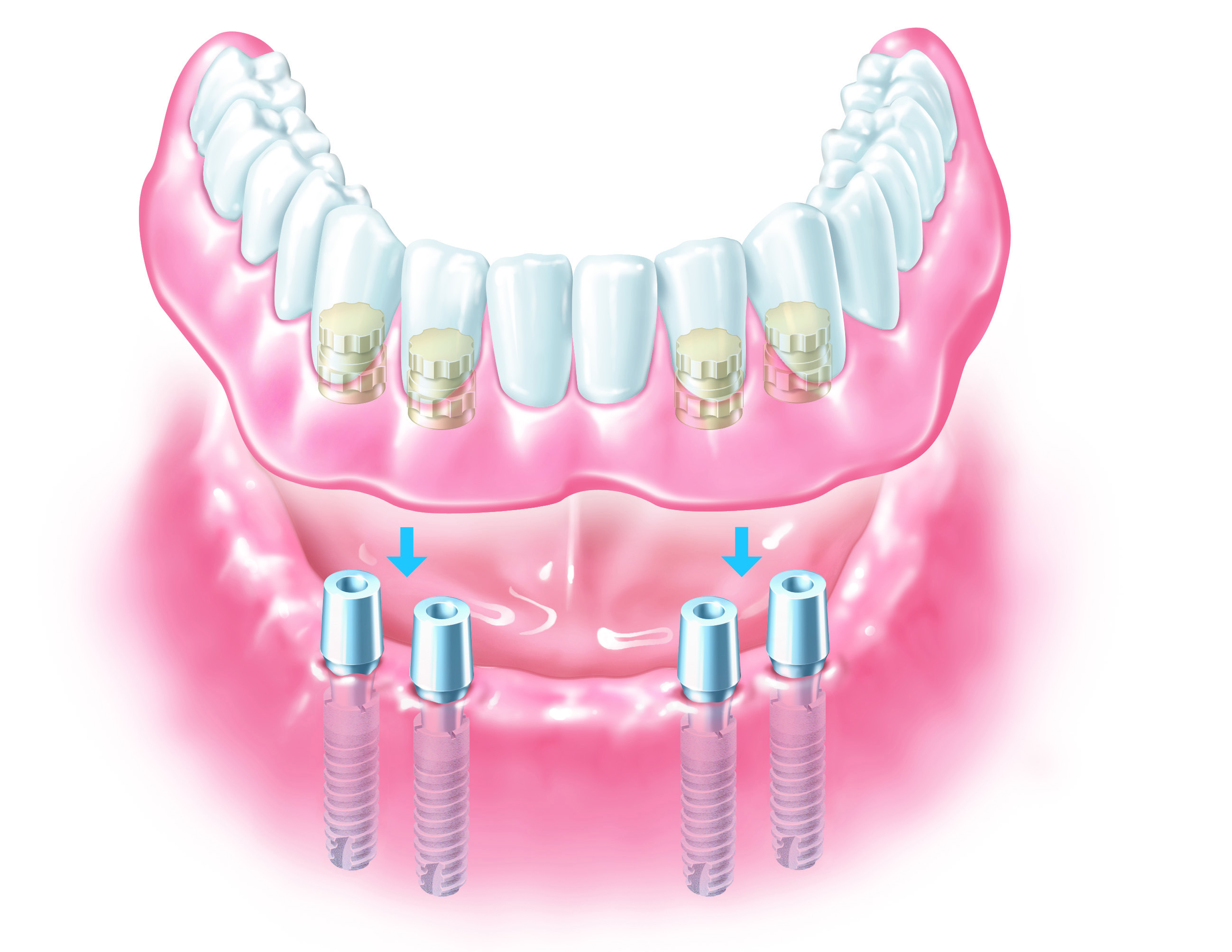
The replacement of missing teeth and the associated soft and hard tissues by prostheses (crowns, bridges, dentures) which may be fixed or removable, or may be supported and retained by implants
A Prosthodontist will work extremely closely with a dental laboratory. It will be the dental laboratory which manufacture your crowns, bridges or dentures to replace any missing teeth. These restorative options are also offered by your general dental practitioner but in some instances the restoration of the missing teeth becomes extremely complex, perhaps combining crowns, bridges and dentures in complex ways. Understanding how these restorations perform together takes specialist knowledge, in this case a Prosthodontist will often help to restore your smile.
You may also find that a prosthodontist will work with a periodontist. The periodontist may place the dental implants (as in the example above) and the prosthodontist may work closely with the dental laboratory to make the denture on top. It is a close coordination of a specialist team to achieve the best result.
Endodontist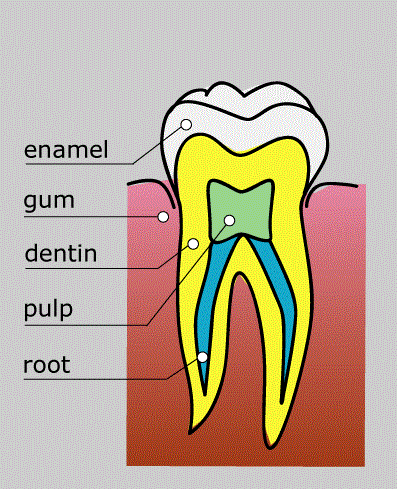
The cause, diagnosis, prevention and treatment of diseases and injuries of the tooth root, dental pulp, and surrounding tissue.
Endodontics is a specialist field which many general dentists do not offer themselves. It takes many years training to be able to work in the small environment which is the root of a natural tooth. Many people think that root canal treatments are painful, the reality is that this type of treatment actually gets you out of pain. The results can be quite immediate!
Working with an endodontist your general dental practitioner is able to save teeth rather than remove them. This is always the preferred option of treatment if at all practical.
Oral Surgery
The treatment and ongoing management of irregularities and pathology of the jaw and mouth that require surgical intervention. This includes the specialty previously called Surgical Dentistry.
There are times when, unfortunately, some form of surgical procedure is required, for example:
- Simple and complex dental extractions
- Removal of Simple and Complex Wisdom teeth
- Removal of retained roots
- Orthodontic extractions
- Exposure and bonding of Unerupted teeth for Orthodontics
This is when an oral surgery specialist will step in and support your general dental practitioner in the more complex surgical procedures.
Restorative Dentistry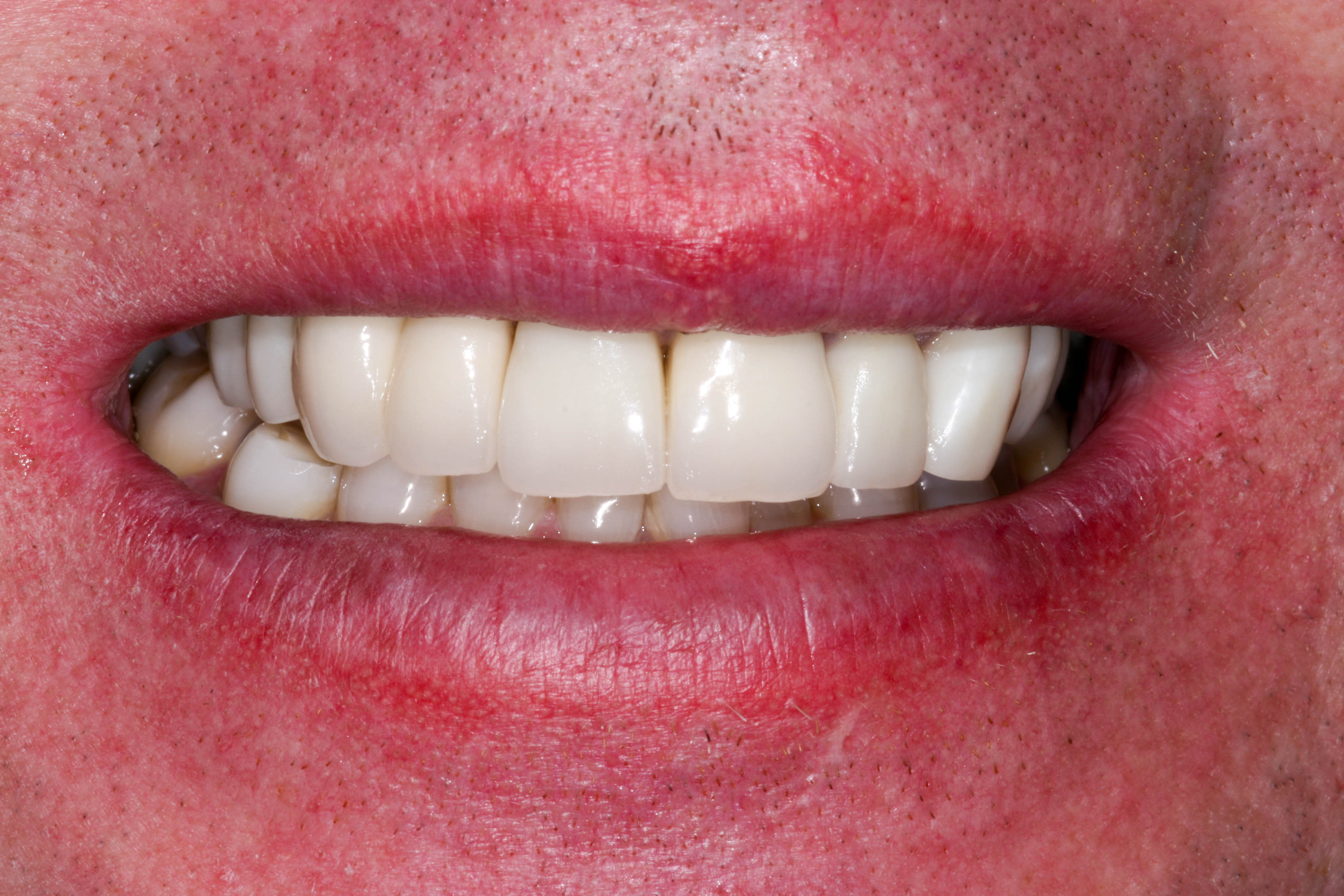
The restoration of diseased, injured, or abnormal teeth to normal function. Includes all aspects of Endodontics, Periodontics and Prosthodontic
A specialist in restorative dentistry works particularly with your natural teeth in order to restore them. This could be the complex combination of crowns, bridges, bonding, looking after the gums or treating complex problems with the teeth themselves. It involves a wide range of skills in order to save teeth.
You only ever get one set of adult teeth so it would make sense to restore them whenever possible, rather than have them extracted and be lost for ever. A restorative specialist helps you do this.
With so many specialists working to help save, restore and generate your perfect smile it can be a little overwhelming to know where to start. Our dental practice in Harrow works with resident specialists, in all areas, we can refer you to the right person for you, alternatively you could search the specialist register on the GDC website.
Have your teeth become crooked again after having braces when you were younger?
 One of the most common reasons for patients visiting the dentist for teeth straightening is relapse after having orthodontics when they were younger. Patients often find that once they stop wearing their retainers that their teeth can begin to move back to where they were before. Coupled with the fact that as we get older our teeth have a tendency to drift forwards and become more overcrowded.
So if you find that your teeth are becoming more crooked again, after having orthodontics as a child, then you are not alone.
So what is the solution?
The European Society of Aesthetic Orthodontics (ESAO) recognises the need for a variety of orthodontic treatments of this nature and ensures that its members provide a qualified, informed choice for patients when considering this type of treatment, Dr Nishan Dixit is pleased to be a member of the ESAO and can offer you a wide range of orthodontic options from his dental practice in Harrow.
Teeth-straightening can be a relatively simple, speedy and painless option if you have crooked teeth, so let’s look at what those options are:
Rapid Tooth Straightening
Within this category of orthodontics fall 3 particular treatments:
- Six Month Smiles
- Inman Aligner
- CFast
Six Month Smiles
 As the name suggests Six Month Smiles offers orthodontics which take, on average, six months to achieve the new look. The system is fixed using tooth coloured wires and brackets to ensure that no one else knows that you have braces fitted. As with most of these aesthetic orthodontic options Six Month Smiles is only used to straighten the front six teeth, often known as the social six.
Inman Aligner
This is a removable appliance, which utilises a revolutionary spring design which both pushes and pulls at the same time depending on where we want teeth to move. The brace can only move your front six teeth by gently de-rotating them and then realigning them. Unlike six month smiles you can take out an Inman Aligner, you need to resist this temptation as much as possible and ensure that you wear your aligner for around 20 hours per day, simply removing it to eat, drink and clean your teeth.
One of the big advantages with the Inman Aligner is due to the revolutionary technology in the springs which enable it to move your teeth very quickly, often in around 12 weeks. If you have a short period of time to have your teeth straightened then the Inman Aligner could be your ideal option.
Cfast
This technique is similar to 6 month smiles in that it utilises fixed orthodontics to move your teeth into their new positions. The system also utilises almost invisible orthodontics with clear braces in some instances. This makes Cfast one of the most versatile orthodontic systems around meaning you get the best teeth, straightening result with the minimum amount of hassle.
Almost Invisible Tooth Straightening
Clear Aligners
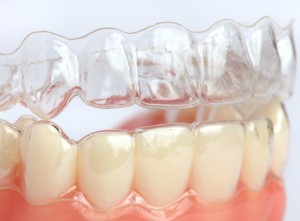 Clear Aligners are exactly that, completely clear. They work by moving your teeth a small amount at a time. You will be provided with a series of aligners which you will typically wear for about two weeks each. Each aligner puts a small amount of pressure on your teeth to move them or rotate them to their new position. Once your teeth have moved a tiny amount you will replace the aligner with the next one in the series.
The art with using clear aligners is for your dentist to choose exactly the right amount aligners for your particular case to ensure that your teeth move gently into their new positions.
Many people like clear aligners as they are virtually invisible to the naked eye, this means that if you have a high profile job or are in the public eye you can have straighter teeth with no one else knowing!
In Summary
Adult Orthodontics are one of the most popular cosmetic treatments requested by patients in many dental practices around the UK, and certainly, this is the case at our practice in Harrow, Middlesex. By offering you a range of treatments and being members of the ESAO you can be sure that you are offered something which fits not only your budget but your exact dental requirements.
We strongly recommend that you keep an open mind with regards to treatment, the descriptions listed above are relatively simple and there are additional requirements for each of them to be used. It may be that your dental situation is more suited to one system than another. So going to your dentist with an open mind allows you to be free to choose the best option to you.
Blue Court Dental Centre offer a free consultation, with our treatment co-ordinator, for anyone wishing to find out more about aesthetic orthodontics for teeth that have moved after having braces as children. Simply complete the download here to request your appointment.
Dr Nishan Dixit is the founder and principal dentist of Blue Court Dental. Patients enjoy his relaxed, friendly and gentle approach while experiencing his meticulous attention to detail. He has a special interest in providing smile makeovers, natural-looking white fillings and cosmetic braces, but also provides a range of treatments from preventative and general dental care to complex dental rehabilitation.
Latest posts by Dr Nishan Dixit (see all)
- Dr Dixit is the new President of British Academy of Cosmetic Dentistry - 28 May 2020
- Does Invisalign hurt? - 9 March 2020
- How Long Does Invisalign Take? - 27 February 2020
Are your gums healthy
Gum infections are the most common cause of adult tooth loss but often go unnoticed as they progress without pain. However, the following are warning signs that shouldn’t be ignored:
- Gums that bleed when brushing/flossing
- Bad breath or bad tastes in the mouth
- Loosening of teeth
- Loss of teeth
- Gums that are red, swollen, or tender
- Gum recession
- Teeth that drift from their original position
In order to prevent gum disease and keep your teeth and gums healthy, we advise:
Brush your teeth twice a day with fluoride toothpaste, especially at bedtime. You should clean them for 2 minutes, making sure you brush every surface of each tooth – be thorough but not forceful as you can cause damage to your teeth and gums.
Make sure youclean between your teeth and under your gumline. We advise you on the best method for your teeth.
Eat a healthy diet. In particular, don’t eat too much sugar, and dont consume sugary foods or drinks too often – we recommend limiting sugar intake to mealtimes only.
Don’t smoke! Smoking has a particulary damaging effect on your oral health. Smokers are four times as likely to suffer gum disease ( the biggest cause of tooth loss among UK adults ).
Visit the practice regulary so we can check your mouth for signs of potential problems and treat them early. Having your teeth professionally cleaned by us also helps protect you from gum disease by removing any hardened plaque and flushing away plaque bio-films.
If you are overdue for a check-up or have any concerns, please give us a call and book an appointment, and let us help you to enjoy healthy teeth and gums for life!
Tips for fresher breath
Tips for fresher breath
1. To test if you have bad breath, simply lick the inside of your wrist, let it dry and sniff. If the smell is bad, you can be fairly sure you have bad breath.
2. Clean in between your teeth with ‘interdental’ brushes or floss. This will help clean all parts of the tooth and remove food caught between teeth.
3. Don’t forget to brush your tongue, or use a tongue scraper.
4. Chew sugar-free gum to stimulate saliva to help prevent your mouth from drying out.
5. If your bad breath continues, visit us at Blue Court Dental for advice and cleaning tips.
THE BENEFITS OF CHEWING GUM
I’ve heard that chewing gum after eating can help prevent fillings. Is this true, and if so how?
As long as it is sugar-free, yes, chewing gum can help to maintain a healthy mouth. This is because it helps to boost saliva flow, helps to wash away food remnants, bacteria and plague, neutralising harmful acids and so helping to reduce decay. According to gum manufacturers, Wrigleys, 80% of dentists now recommend chewing sugar-free gum after meals
I have sensitive teeth after whitening.
I have sensitive teeth after using the home whitening kit! Is this normal?
Yes, this is perfectly normal. You can try to add Sensodyne tooth paste into your trays every alternate day.